
Send e-mail from Next.js with 1billion
#next.js#javascript#webhook
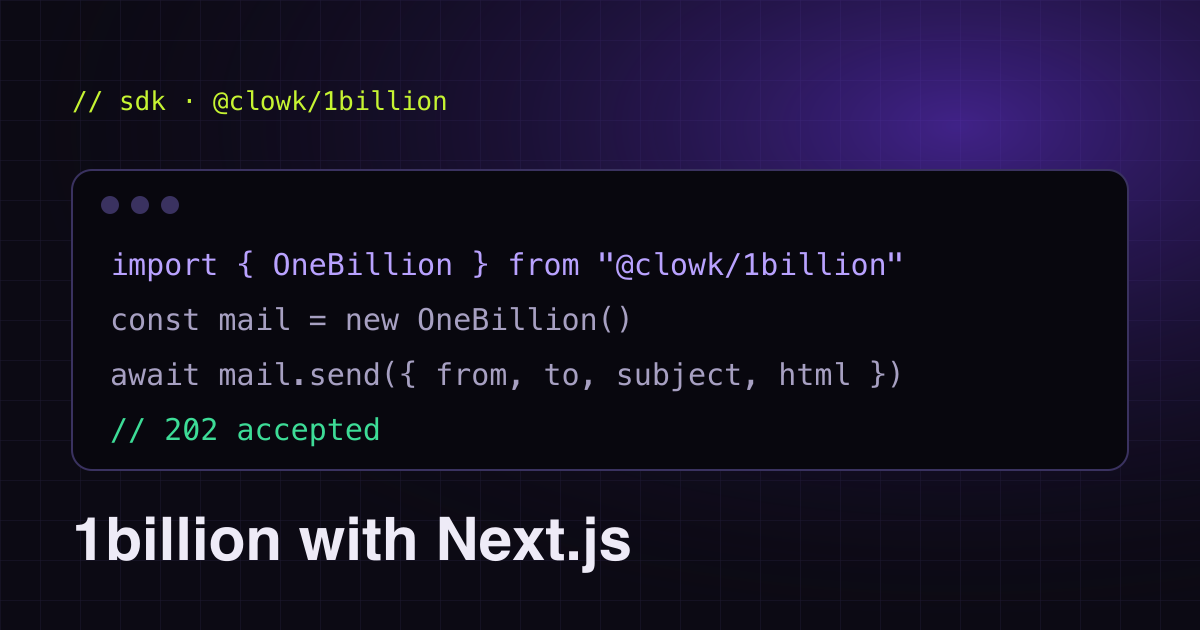
This post sends a login link from a Next.js app (App Router) with @clowk/1billion, the JavaScript SDK of 1billion. It has no dependencies: it uses only fetch.
1. Install and set the key
pnpm add @clowk/1billionMake an API key in the console and verify the domain that you send from. Then put the key in .env.local:
ONEBILLION_API_KEY=<your API key>Do not use the NEXT_PUBLIC_ prefix. The key must stay on the server, and the SDK has no browser build.
2. One client for the app
// lib/mail.ts
import { OneBillion } from "@clowk/1billion"

export const mail = new OneBillion() // reads ONEBILLION_API_KEY
3. Send from a route handler
// app/api/login/route.ts
import { mail } from "@/lib/mail"

export async function POST(request: Request) {
  const { email } = await request.json()

  await mail.send({
    from: "Acme <hi@acme.com>",
    to: email,
    subject: "Your login link",
    html: `<a href="https://acme.com/login?token=…">Log in</a>`,
    priority: "high",
  })

  return Response.json({ ok: true })
}
send returns when 1billion has the mail (202, status accepted). The delivery runs after that, with its own retries. priority: "high" puts mail that a person waits for, such as a code or a login link, first.
4. Or from a server action
// app/login/actions.ts
"use server"

import { mail } from "@/lib/mail"

export async function sendLoginLink(formData: FormData) {
  const email = String(formData.get("email"))

  const { error } = await mail.emails.send({
    from: "Acme <hi@acme.com>",
    to: email,
    subject: "Your login link",
    html: `<a href="https://acme.com/login?token=…">Log in</a>`,
  })

  if (error) return { error: error.message }

  return { ok: true }
}
emails.send is the call of resend.emails.send. It returns { data, error } and never throws, which fits a server action that returns a state to the form. If you come from Resend, only the import and the class change.
5. Send each mail once
A user clicks twice, or your code retries. Give the mail an idempotency key that names it:
await mail.send({ ...message, idempotencyKey: `login-${userId}-${token}` })The same key in 30 days returns the first answer and sends nothing again. The SDK also retries a 503 or a network error with the same key, so its own retries never send a mail twice.
6. Handle the errors
import { OneBillionError } from "@clowk/1billion"

try {
  await mail.send(message)
} catch (error) {
  if (!(error instanceof OneBillionError)) throw error

  if (error.noCredits) {
    // 429: no credits for these recipients today
  } else if (error.refused) {
    // 422: a bad message, a domain that is not verified, or a recipient that failed a check
  }
}
7. Verify the webhook
1billion tells you what happened to each recipient. Read the raw body, then verify the signature:
// app/api/webhooks/1billion/route.ts
import { OneBillion } from "@clowk/1billion"

export async function POST(request: Request) {
  try {
    const event = OneBillion.verifySignature({ payload: await request.text(), headers: request.headers })

    if (event.type === "bounced") await markBounced(event.to)

    return new Response(null, { status: 200 })
  } catch {
    return new Response(null, { status: 401 })
  }
}
The secret comes from ONEBILLION_WEBHOOK_SECRET. A bad signature, or a timestamp older than 5 minutes, throws.
That is all. The full reference is in the README of the SDK.
Start now
The first 100 mails of each day are free, every day: each workspace gets 100,000 credits at midnight, with no card. Log in to the console, add your domain, and send your first mail in a few minutes with the quickstart.
Re: Send e-mail from Next.js with 1billion
The first 100 mails of each day are free, every day. No card. Log in and send your first mail in a few minutes.
Start sending free