
What a bounce is and what a complaint is
#bounce#complaint#suppression#deliverability
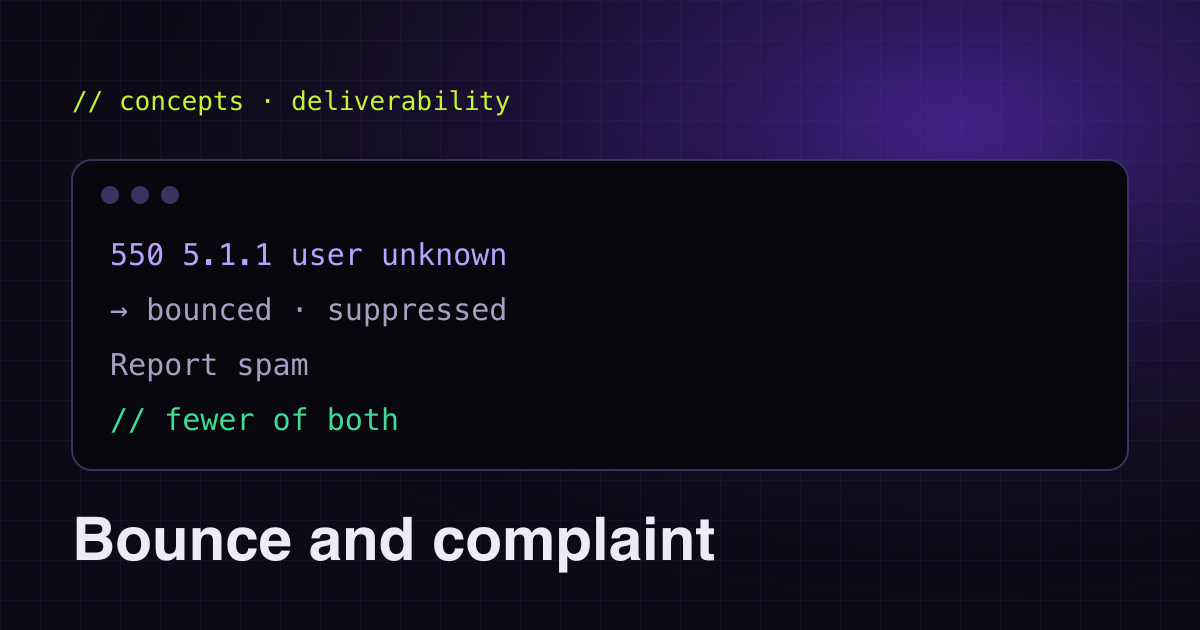
Two signals tell a mailbox provider that a sender is careless: bounces and complaints. They come from different places, but both make your next mail more likely to go to spam.
A bounce: the server says no
A bounce is a refusal from the server of the recipient. It comes as an SMTP answer, with a code and a short text:
550 5.1.1 user unknownThe first digit tells the type:
5xx, a hard bounce: a permanent failure. The mailbox does not exist, or the domain does not take mail. The next try gives the same answer.4xx, a soft bounce: a temporary failure. The mailbox is full, or the server is busy. A later try can pass.
A bounce can also come late: the server accepts the mail and then sends a bounce message to the envelope sender.
Many hard bounces tell the provider that you send to a list that you do not keep clean, for example a list that you bought or a list of old addresses.
A complaint: the person says no
A complaint is a person who clicks Report spam on a mail that they got. The mail was delivered, but the recipient did not want it.
Some providers send the complaint back to the sender in a feedback loop. Gmail does not tell you which person complained, but it counts the rate, and its sender guidelines ask you to keep the spam rate under 0.3%.
A complaint usually comes from a person who:
- does not remember that they signed up,
- can not find how to stop the mail,
- gets more mail than they expected.
How to have fewer of both
- Check an address before you keep it. A typo such as
gmial.combecomes a hard bounce later. - Never send again to a hard bounce.
- Make it easy to leave. A person who finds an unsubscribe link does not click "Report spam".
- Send marketing from another domain. Then a person who leaves your newsletter still gets your login mail.
What 1billion does
Before the send. POST /send checks each recipient for free: the syntax, a domain that receives mail, no disposable inbox and no role address (contact@, noreply@). A recipient that fails gets 422, and nothing is sent or charged. You can also call POST /validate on a sign-up form, and send nothing.
After a bounce. The message gets the status bounced, and last_error has the answer of the server. Your app gets a bounced webhook with the same text in detail. A hard bounce puts the address on the suppression list of the app: a new mail to it becomes a free message with the status suppressed. When the address works again, take it off with DELETE /suppressions/{address} or in the console.
For complaints. Turn on List-Unsubscribe on the domain. Each mail then has the one-click unsubscribe headers (RFC 8058), so Gmail and others show an Unsubscribe button next to the sender. A person who leaves gives an unsubscribed webhook, and stops getting mail from that domain only.
The reputation of the workspace. When the reputation of the last 30 days is under 90%, with 100 sends or more, the sends of the workspace are paused with 403, and a person reviews it. This keeps one careless sender from hurting the others.
Start now
The first 100 mails of each day are free, every day: each workspace gets 100,000 credits at midnight, with no card. Log in to the console, add your domain, and send your first mail in a few minutes with the quickstart.
Re: What a bounce is and what a complaint is
The first 100 mails of each day are free, every day. No card. Log in and send your first mail in a few minutes.
Start sending free